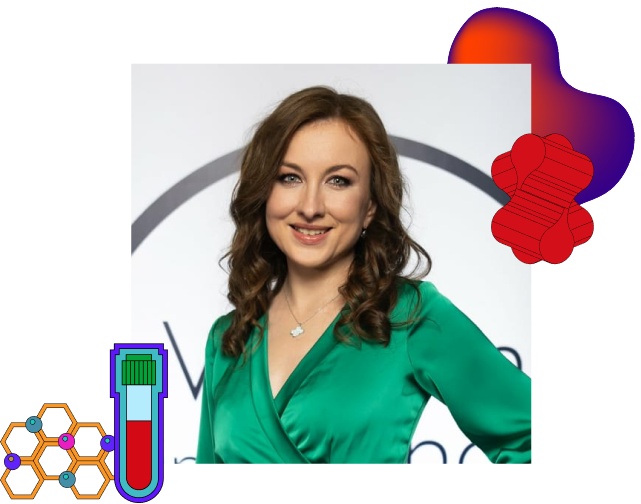
Olha Strilbytska
A researcher of aging and lifespan extension. She currently studies PTSD, focusing on pharmaceutical approaches and the biochemical mechanisms that could change how this disorder is treated.
Was there a specific moment when you realized you wanted to focus specifically on aging?
I remember the first time I held a test tube with fruit flies in my hands. I was shown and told how these tiny insects help scientists study the mechanisms of cellular aging and aging of the organism as a whole. It was astonishing to realize that such a small model system could reveal insights that may help people live longer and healthier lives. During my very first experiment, I observed how certain genetic variations in fruit flies affected their lifespan. That realization—that science can directly improve quality of life—was the moment I decided to study aging.
Is there something about the human body that still amazes you?
What amazes me most is how little we notice the immense amount of work our cells perform every second. While we go about our daily lives, thousands of biochemical reactions are constantly taking place in our bodies, sustaining the function of cells, organs, and entire systems.
If we simplify it a lot: what does science already know for sure about aging, and what remains the biggest mystery?
Every cell in our body works like a small factory: it produces energy, synthesizes proteins, repairs DNA, and maintains internal balance. We know for certain that aging occurs due to the gradual accumulation of cellular damage and a decline in the cells’ ability to repair themselves. At the same time, science is still trying to understand why some people or animals age slowly and remain healthy and active into old age, while others lose their functions much earlier. The answer to this question may hold the key to extending active and healthy lifespan.
If you had to explain in just a few sentences why society needs knowledge about the biochemistry of aging, what would you say?
Knowledge about the biochemistry of aging helps us understand how human health changes with age and what kind of support it needs. This makes it possible to maintain health more effectively as people grow older, reduce the burden on healthcare systems, and improve quality of life. This knowledge is important not only for scientists but for everyone who wants to stay active and healthy for longer.
You also work with PTSD. What has been the most unexpected aspect of this field for you?
What strikes me most is that PTSD does not develop in everyone after traumatic experiences—and even among those who are diagnosed, the disorder can sometimes regress without psychotherapeutic or pharmacological intervention. This highlights the remarkable neuroplasticity of the brain and the nervous system’s capacity for self-regulation, including the restoration of synaptic connections, adaptation of neurotransmitter systems, and regulation of hormonal pathways. At the same time, the precise molecular and cellular mechanisms behind these processes remain an active area of scientific research.
Content was produced by the INSCIENCE organization as part of the “WOMEN IN SCIENCE” project in the framework of the “EU 4 Gender Equality: Together against gender stereotypes and gender-based violence” programme (phase 2), funded by the European Union, implemented jointly by UN Women and UNFPA.
Content was conducted with the financial support of the European Union. Its content is the sole responsibility of the INSCIENCE organization and do not necessarily reflect the views of the European Union.
 Previous story