Khrystyna Gnatenko
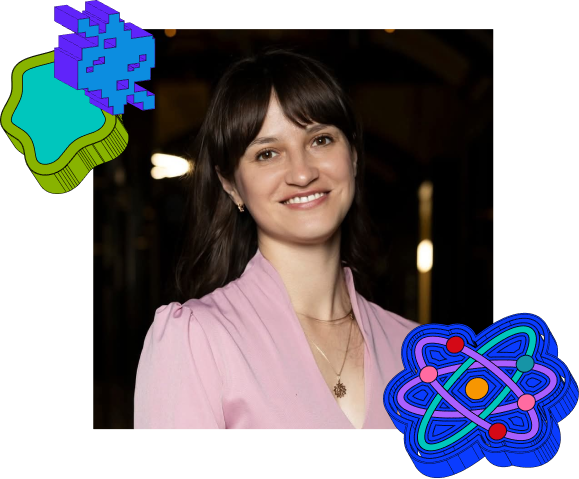
Her research interests focus on quantum mechanics and quantum programming. She also teaches students, actively popularizes science among children and adults, and is a professional violinist. In 2020, Khrystyna Hnatenko became the youngest Doctor of Physical and Mathematical Sciences in Ukraine.
You are the youngest Doctor of Physical and Mathematical Sciences in Ukraine. Was there a moment of doubt along this path when you wanted to stop, and what helped you keep going?
The period of research whose results became part of my doctoral dissertation is something I remember as extremely intense and, at the same time, deeply engaging. I was genuinely fascinated by solving problems in quantum theory and working on scientific papers. Still, even work you love can sometimes be exhausting. In those moments, changing activities helped me the most: I would pick up my violin or sit down at the piano.
You work a lot with young people. What has this work taught you, and what do you value most about it?
Sincere enthusiasm, curiosity, and courage in striving for scientific results. Interaction between scientists and young people is incredibly important and mutually enriching. I clearly remember how, during my school years, my teachers inspired my interest in science. The joyful emotions I felt during research project defenses at the Junior Academy of Sciences of Ukraine competitions are still vivid in my memory. That is why, in working with young people, I value most the opportunity to ignite a spark of curiosity and to watch it grow into a steady flame—when students develop a genuine love for the subject.
What is more difficult for you: solving scientific problems or explaining the basics of quantum physics to someone without a specialized background?
Both are challenging in their own way. Explaining the fundamentals of quantum physics to a broad audience requires the ability to find accurate analogies, explain complex concepts in accessible language, and choose words and approaches that best match the audience’s level of knowledge and interests. At the same time, it is crucial to maintain precision, avoid misconceptions, and keep listeners engaged. In my opinion, however, solving a new, cutting-edge scientific problem is more difficult, as it demands long-term effort, deep immersion, and a thorough understanding of the latest research and creative, non-standard approaches.
Does your musical education help you think differently in science—for example, when searching for solutions or explaining complex ideas?
From my own experience, I am convinced that musical training is very helpful in scientific research. Becoming a professional musician requires a great deal of systematic work and daily improvement. This process combines deep thinking, analysis, creativity, and disciplined routine—all of which are equally essential in scientific work. In addition, when searching for solutions and working on complex problems, I often listen to music—it helps me immerse myself more deeply in the scientific world. I also write scientific papers while listening to music. For me, this approach is more effective.
What in quantum physics continues to inspire genuine fascination in you, even after years of working in this field?
I am truly fascinated by the rapid development of quantum technologies and the steady improvement of quantum computers year after year. It is incredibly exciting to combine theoretical research—deriving formulas and discovering new patterns on paper—with the opportunity to run quantum computing experiments, implement my own quantum algorithms on quantum processors, and obtain results directly. Through programming on quantum computers, I feel not only like a physicist but also, in part, like an experimentalist. This combination is especially exciting for me.
 Next story