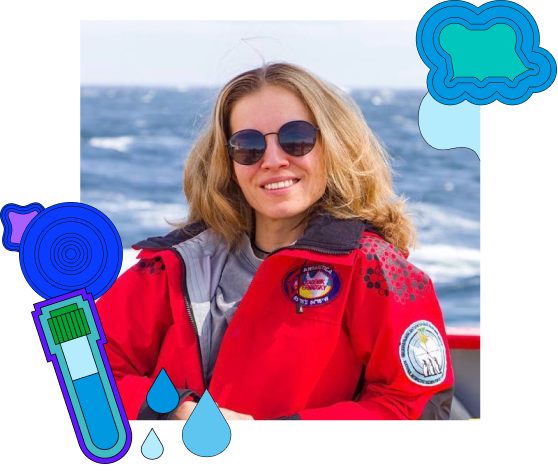
Mariia Pavlovska
She studies marine microorganisms in Antarctica and the Black Sea. Currently, her research focuses on identifying compounds produced by marine extremophiles that may be beneficial for humanity.
Which microorganisms in Antarctic waters impress you the most?
Microorganisms, in general, are astonishing life forms—they can adapt to some of the most extreme environmental conditions on Earth. Despite extensive research, the microbial world of the Southern Ocean still holds many unknowns. A fascinating example is bacteria of the genus Psychromonas, which have developed unique adaptations to the conditions of the Southern Ocean. In particular, they can remain metabolically active at temperatures close to the freezing point of seawater (–1.8°C). This is made possible by enzymes that function at low temperatures, a specific composition of the cell membrane, and the synthesis of antifreeze compounds that prevent ice crystals from forming inside the bacterial cell.
How does studying Antarctic microorganisms help us understand global ocean processes?
Antarctic microorganisms may seem invisible, but in reality, they drive many global processes in the oceans and even influence Earth’s climate. In the waters of the Southern Ocean, microscopic algae—phytoplankton—absorb carbon dioxide from the atmosphere through photosynthesis. Bacteria then take over, “processing” the organic matter produced by phytoplankton. How exactly these microorganisms function determines whether carbon is released back into the atmosphere or stored in the ocean for hundreds of years. In this way, Antarctic microbes effectively help the ocean act as a massive natural sink for CO₂. In addition, interactions between bacteria and microalgae shape which nutrients—and in what form—are available to higher trophic levels, from krill to whales.
What is your most vivid memory from working in Antarctic waters?
One of my most vivid memories was my first encounter with a whale. We were working from a small boat, collecting seawater samples to analyze bacteria, when a huge humpback whale appeared right next to us. It was the first time I saw one dive deep and lift its tail above the water. It was a little frightening—we felt incredibly small beside it—but at the same time, it was breathtakingly beautiful.
What practical applications come from studying microorganisms in extreme environments?
Antarctic microorganisms are adapted to the cold, oxygen-rich waters of the Southern Ocean. As a result, they can synthesize cryoprotectants, antioxidants, and enzymes that function at low temperatures. These enzymes are of great interest to biotechnology and industry, as many processes that typically require heating could be carried out without additional energy input. Using enzymes from Antarctic marine microorganisms allows technological processes to operate at low temperatures, significantly reducing energy consumption. Antifreeze proteins and cryoprotectants produced by these organisms also show promise for use in cryopreservation, particularly for the long-term storage of biological materials at low temperatures. In addition, Antarctic bacteria can produce biologically active compounds, including antibiotics—some of which have already demonstrated effectiveness against treatment-resistant infections.
What unexpected challenges have you encountered while working with marine microorganisms?
Unexpected challenges can arise when working with any living organisms. As a scientist, you usually have a hypothesis in mind and expect certain results—but bacteria often have “plans of their own.” They may stop growing in laboratory conditions in a particular medium or require the presence of other bacteria or microalgae to survive. As for working specifically in Antarctica, what surprised me most was just how cold it can be in a rubber Zodiac boat. Of course, I knew warm clothing was essential, but I never quite got used to the fact that my feet would freeze no matter how many pairs of socks I wore.
 Previous story