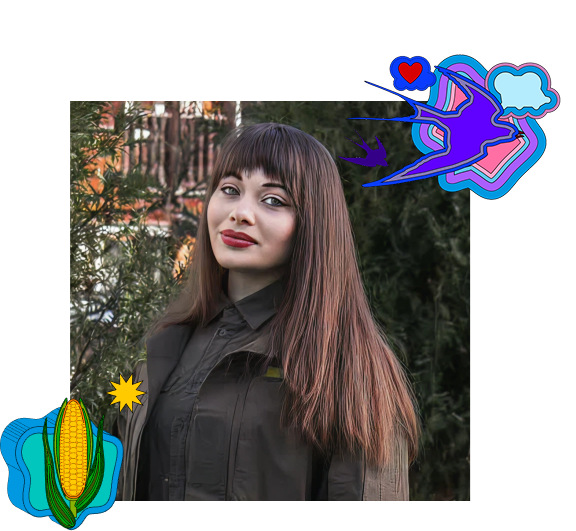
Diana Yuzyk
Senior research fellow at the Cheremoskyi National Nature Park in Bukovyna. For over ten years, she has been studying birds—their populations, behavior, and role in natural ecosystems.
What led you to ornithology? When did you realize you wanted to study birds professionally?
I’ve been interested in birds since early childhood, but the real turning point came during my first bird-banding experience in Crimea. That was the moment I truly understood how much information a single small metal ring can reveal about a bird. I felt as if an entire world of stories was opening up before me—stories about migration, behavior, and the lives of birds. It was a fascination not only with the beauty of nature but also with the scientific approach to studying it. That’s where I realized I wanted to study birds professionally and systematically. Since then, this passion has only grown stronger.
Which skill or personal trait helps you most in your work as a scientist?
Attention to detail and the ability to stay focused for long periods are probably the most important. Ornithology is a field where a single overlooked vocalization or a small behavioral detail can make all the difference. Persistence also plays a crucial role, as fieldwork often involves physical challenges and unpredictable conditions. It’s important not to give up when data comes in slowly or when you have to work in silence for hours at a time. Honesty with yourself is equally essential in science—it’s what helps you remain objective. Together, these qualities shape my professional approach to research.
Which bird has surprised you the most over the years of your research?
The white-throated dipper has surprised me the most. It’s a bird that always seems to stay one step ahead of your observation. It dives into the water instantly and disappears so quickly that even experienced researchers struggle to follow it. Its winter behavior is especially striking: the dipper plunges into icy water as if it were the most natural thing in the world. It confidently moves beneath the ice and through fast currents, using every corner of the river. Its resilience and agility are a constant reminder of how complex and fascinating even small mountain birds can be.
Do you have a favorite place for observations—somewhere you always want to return to?
Yes, for me it’s the high-altitude spruce and fir forests of Cheremoskyi National Nature Park. That’s where I most often feel that I’m returning both to myself and to true field science. These forests have a special atmosphere of silence, where every bird sound feels like a discovery. Each season brings new accents—spring songs, summer contact calls, autumn movements. I know dozens of spots there that I always want to return to, just to hear familiar voices again. For me, it’s a quiet refuge where science and nature come together in harmony.
What do people most often misunderstand about birds or about the work of an ornithologist?
Many people imagine ornithology as a romantic profession—endless walks with binoculars. In reality, fieldwork often requires endurance and a willingness to work in cold, wind, and rain, with no guarantee of success. Sometimes hours of waiting and silence are needed for just a few moments of observation. Moreover, there’s a large amount of computer-based work: sound analysis, data processing, statistics, mapping, and reporting. People often underestimate how precise and systematic data must be to draw even a single reliable conclusion. And most importantly, birds are far more complex than they seem—their voices, behavior, and ecology demand careful attention and respect.
 Previous story