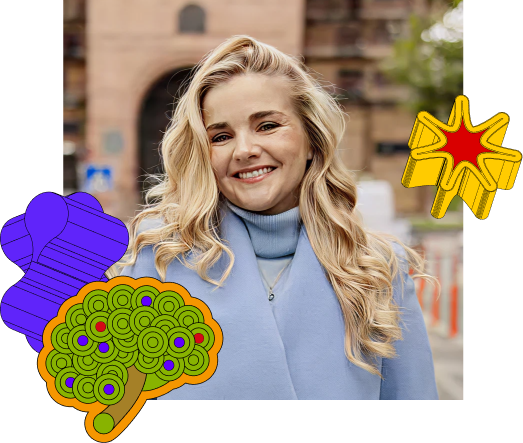
Vira Iefremova
She studies rare genetic disorders and explores ways to treat them using stem cells. She earned her PhD in Germany, worked as a postdoctoral researcher in Berkeley, and currently works at a biotechnology company in the United States.
How would you explain to someone without a scientific background why brain research matters?
Brain research is an attempt to understand the very essence of who we are: memory, emotions, creativity, and decision-making. Every movement and every thought emerges from a complex network of nerve cells that we are only beginning to understand truly. Today, we can reprogram ordinary skin or blood cells into induced pluripotent stem cells and grow neurons—or even miniature brain models called organoids—from them. This allows us to observe disease at the cellular level, recreate its development in the lab, and test new therapeutic approaches without putting patients at risk. This is especially valuable for rare diseases, where patients often have no available treatments—or even enough data to develop them. Such models literally allow us to «bring the disease back into a Petri dish» and understand how it might be stopped. Ultimately, by studying the brain, we move closer to restoring people’s ability to be themselves. In practical terms, this research helps us more precisely repair nervous system function and improve patients’ quality of life.
Which scientific discovery has recently impressed you the most?
I was deeply impressed by the results of a clinical study showing that severe, drug-resistant epilepsy can be treated using a patient’s own genetically «corrected» cells. In this approach, researchers took skin cells, reprogrammed them into stem cells, corrected the genetic error, and then grew specialized inhibitory neurons from them. These brain cells act like a natural «brake»: they restrain overly active neural networks and restore the balance between excitation and inhibition during neural signaling. A lack or malfunction of these cells can lead to epileptic seizures. The resulting neurons were transplanted into the brain region where seizures originated, and over time they integrated into local neural circuits. In some patients, seizure frequency declined by nearly 90%, and this effect has persisted for more than two years after the cell transplantation. For me, this is one of the clearest examples of how modern cell technologies can go beyond symptom control and actually restore brain function—offering hope to people who previously had no effective treatment options.
What about the brain still feels mysterious, even after years of research?
Despite years of study, I am still amazed by how neurons can self-organize into complex networks without any kind of «central conductor». Even under laboratory conditions, when we grow neurons from reprogrammed skin cells, they find each other, form connections, and create rhythmic activity patterns that resemble those in the human brain. Equally mysterious is how individual human traits emerge: slightly different activity patterns can result in different memories, different ways of reacting to the world, and entirely different modes of thinking. What fascinates me most is that this vast neural «cosmos» can be disrupted by a tiny change in a single gene—and yet can also recover if the right cell is put back in the right place. This combination of extreme vulnerability and remarkable plasticity always leaves me with the sense that we are seeing only the tip of the iceberg.
Has working in neuroscience changed how you relate to your own emotions, decisions, or memory in everyday life?
Yes, working with brain cells has profoundly changed how I relate to my own emotions and reactions. When you see how plastic the brain is, you become gentler with yourself: emotions are not a «weakness» but the result of specific neural networks that can be trained and supported. Researching rare genetic conditions has also taught me patience. A single small mutation can change how a cell behaves—and, as a result, reshape an entire human life. There is one more thing that continues to amaze me: the deeper you explore the brain, the clearer it becomes how many factors have to align for us to become who we are. A slightly different neural rhythm, a different chemical environment, or a different experience—especially in childhood or adolescence—and you end up with a different person, a different story, a different response to the world. This knowledge fundamentally changes how you see yourself and others: our emotions and decisions are the outcome of a complex interplay of countless factors.
If you hadn’t chosen neuroscience, which other scientific field might have interested you—and why?
If I weren’t working with brain cells, I would most likely be studying space. These two fields have more in common than it might seem: both the brain and the universe are systems where most processes are hidden, and each new measurement reveals an entirely new layer of the unknown. What fascinates me most about space is the combination of fundamental physics and almost philosophical questions about the origins of matter, time, and life. As in neuroscience, there is a sense of infinity and intellectual honesty in facing the unknown: you work with things you cannot observe directly, yet you can reconstruct tiny fragments of a much larger picture. I think that if not for brain cell models, I would be searching for answers in distant galaxies.
 Previous story