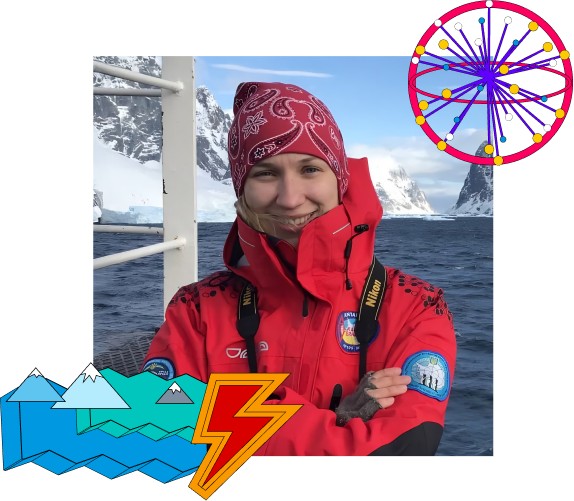
Anastasiia Chyhareva
Her research focuses on cloud formation and precipitation in Antarctica. A deeper understanding of these processes helps improve weather forecasting and provides better insights into climate change.
Which meteorological phenomenon in Antarctica raises the most scientific questions today, and why?
One of the biggest challenges in modern polar meteorology is the phenomenon of atmospheric rivers—narrow corridors of intense heat and moisture transport from the tropics toward Antarctica. These systems create a complex scientific paradox. On the one hand, they bring critically important snowfall that contributes to glacier mass gain. On the other, they can trigger extreme surface melting and rainfall, which are highly destructive for glaciers.
When atmospheric rivers pass over mountainous terrain, such as the Antarctic Peninsula, they generate foehn winds on the leeward slopes. This process leads to the formation of meltwater lakes and accelerates the collapse of ice shelves. The key problem is that current models struggle to accurately represent the microphysical properties of clouds that form under these conditions. As a result, it remains unclear whether atmospheric rivers will ultimately help stabilize the Antarctic ice sheet or become a major driver of its collapse in a warming climate.
How has working with the Antarctic sky changed your perception of “ordinary” weather—rain, snow, clouds over a city?
In Antarctica, the sky feels like a vast dome. You can see weather systems developing hundreds of kilometers away: a front approaching, a wall of precipitation forming, while sunshine still lingers on the horizon. You physically sense atmospheric processes unfolding on a regional scale. Due to the nature of atmospheric circulation there, the sky appears much lower.
In cities, by contrast, you feel as if you’re standing at the bottom of a well—buildings block up to 90% of the sky. When rain begins, it often comes as a surprise because you rarely see where it originates. In Antarctica, you become accustomed to watching precipitation approach long before it arrives. Urban environments simply lack the spatial openness and sky visibility that become second nature in polar regions.
What role does international cooperation and collaboration between Antarctic stations play in studying weather and atmospheric processes in the polar region?
International cooperation is essential for building a coherent meteorological picture of Antarctica. Satellites still cannot provide meteorologists with continuous, high‑quality atmospheric data for this region, making ground‑based observation stations absolutely critical.
Because stations are separated by vast distances, no single country can monitor the continent alone. Scientists therefore exchange data in real time to validate synoptic models, particularly within international initiatives such as the Year of Polar Prediction and InSync. This collaboration allows researchers to track atmospheric fronts and cyclones across the continent, forming an uninterrupted chain of observations.
Joint research projects and the standardization of instruments ensure that data collected at Ukrainian, Chilean, or U.S. stations are comparable and scientifically robust. In effect, international cooperation turns remote Antarctic bases into a single global sensor capable of detecting even the smallest changes in Earth’s climate system.
How does observing cloud formation and precipitation in Antarctica improve weather forecasting and climate projections?
Antarctica offers a unique opportunity to study the microphysical properties of clouds and precipitation without significant industrial pollution. Accurately determining the ratio of liquid water to ice in polar clouds is crucial for understanding Earth’s radiation balance.
Ground‑based measurements help verify satellite data, which often misinterpret low‑level clouds as snow cover—an issue that previously caused substantial forecast errors. In addition, detailed precipitation monitoring enables more precise estimates of the Antarctic ice sheet’s mass balance, helping scientists assess whether snowfall accumulation can offset ice loss.
These observations allow researchers to test weather and climate models and deepen our understanding of the processes driving changes in Earth’s climate system.
Are there atmospheric phenomena you’ve observed only in Antarctica, unlike anywhere else on Earth?
Antarctica provides ideal conditions for observing nacreous clouds, also known as polar stratospheric clouds. They form in the stratosphere at altitudes above 15–20 kilometers, under extreme temperatures below −85 °C.
These clouds appear as vast, unnaturally bright, iridescent streaks across the dark sky. They can glow even at night, reflecting sunlight from below the horizon—an otherworldly sight found almost nowhere else on the planet.
 Previous story